Sixty and Standing Ground: A Realistic Path Into Self-Defense Training After 50
Photo: Eva Rinaldi, CC BY-SA 2.0, via Wikimedia Commons
Walk into most martial arts schools in the United States and you'll notice a demographic pattern: a floor full of children, a scattering of adults in their twenties and thirties, and very few students over fifty. This is not because older adults lack interest. It's because the industry has done a poor job of communicating something important — self-defense training is arguably more valuable, and more adaptable, later in life than at any other stage.
The assumption that martial arts belongs to the young rests on a narrow definition of the discipline. If your mental image is a twenty-something throwing spinning kicks in a competition ring, then yes, fifty-plus beginners face a steep curve. But self-defense is not competition. It is awareness, decision-making, positioning, and a small repertoire of reliable physical responses. Every one of those components can be trained — and improved — well past sixty.
Why Older Adults Face Real and Specific Threats
Consider who criminals actually target. Research on victimization consistently shows that predators select for perceived vulnerability, and age signals vulnerability. Older adults are disproportionately targeted in street robberies, home invasions, and — perhaps most pervasively — in fraud schemes that blend manipulation with intimidation.
The confidence dimension matters more than most people realize. An assailant conducting a quick visual assessment is reading posture, gait, and eye behavior. Training that improves how you carry yourself changes that read. This is not speculation; it is the same logic security professionals apply when they talk about "projecting as a hard target."
There's also the physical reality: falls are the leading cause of injury-related death among Americans over sixty-five, according to the CDC. Balance work, which sits at the core of nearly every traditional martial art, directly addresses that risk. A sixty-five-year-old who trains breakfalls and stability for six months has reduced a threat that is statistically far more likely to harm them than a street assault.
What Needs to Change in the Training
An honest program for the over-fifty student makes modifications, not concessions. The distinction matters.
Joint-safe technique selection. High kicks and deep twisting stances have no monopoly on effectiveness. Palm strikes replace closed-fist punches for anyone concerned about hand and wrist integrity — and honestly, palm strikes are safer for beginners of any age. Low-line kicks, elbow strikes, and knee strikes deliver meaningful force without demanding flexibility the body no longer has.
Balance as a first-class priority. Single-leg drills, controlled weight shifting, and slow-motion movement patterns build the stabilizer strength that protects against falls both in and out of the training space.
Controlled sparring, or none at all. Hard sparring carries elevated injury risk for older students, particularly regarding joints and head impact. Scenario-based training — positional work, escape drills, verbal boundary-setting — delivers the decision-making benefits without the wear and tear.
Recovery built into the schedule. Two or three sessions per week with rest days between them outperforms daily training that the body cannot absorb.
An Eight-Week Starter Framework
This framework assumes no prior training and no equipment beyond open floor space. Consult a physician before beginning, particularly if you have cardiovascular or orthopedic conditions.
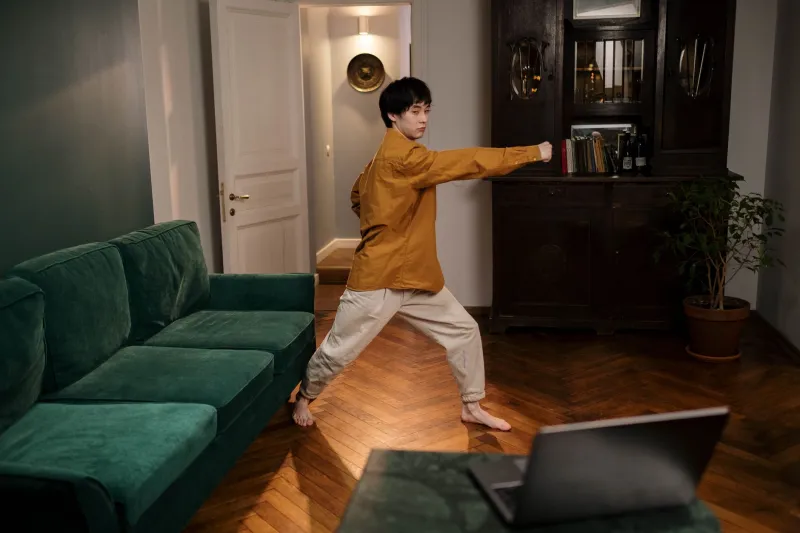
Weeks 1–2: Foundation. Three sessions per week, twenty minutes each. Begin every session with five minutes of walking or marching in place. Learn a stable fighting stance: feet shoulder-width, staggered slightly, knees soft. Practice shifting weight forward and back without crossing your feet. Finish each session with two minutes of single-leg balance, holding a chair for support if needed.
Weeks 3–4: Basic tools. Add palm strikes and elbow strikes, first in the air and then against a cushion or pillow braced against a wall. Focus on hip rotation — power comes from the hips, not the arms. Continue balance work, now without the chair. Sessions extend to twenty-five minutes.
Weeks 5–6: Movement and voice. Combine your stance, strikes, and lateral footwork. Practice stepping off-line at a forty-five-degree angle — the fundamental escape movement in most self-defense systems. Add verbal assertion: a loud, practiced "Back off!" delivered from the diaphragm. Voice work feels awkward; do it anyway. It is one of the most field-tested tools in personal safety.
Weeks 7–8: Integration. String the pieces together in scenario format: recognize a simulated approach, reposition, issue a verbal boundary, and strike a target if the scenario continues. If you plan to join a school, this is the right time — you'll arrive with fundamentals that most new students lack.
The Case for Starting Now
The physical benefits — balance, strength, mobility — compound over time, which means every month of delay is a month of benefit forfeited. But the deeper argument is about agency. Learning to protect yourself reframes the relationship between you and the world around you. Fear of victimization shrinks social lives, keeps people off evening walks, and quietly narrows existence. Training reverses that.
The over-fifty student often brings something the twenty-something cannot: patience, attention to detail, and the wisdom to know that consistency beats intensity. Those are not limitations to work around. They are advantages to build on.