Improvised Defense: Turning What You Already Carry Into a Personal Safety Advantage
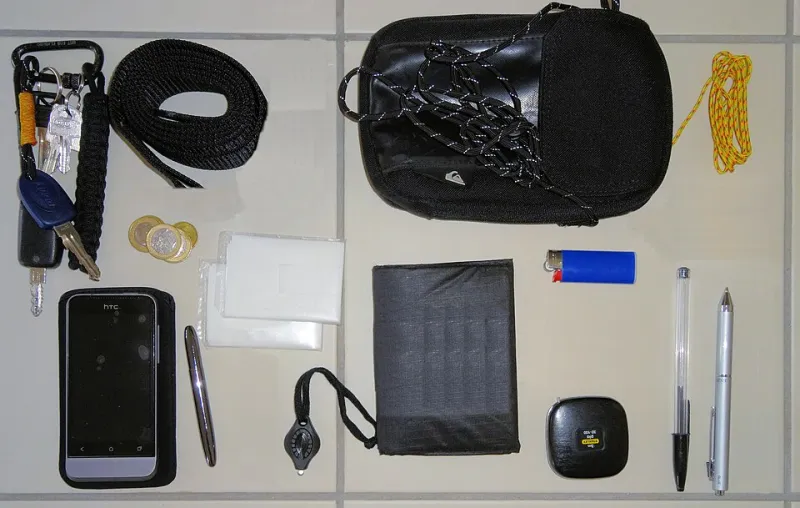
Photo: MONDIZOU, CC BY-SA 4.0, via Wikimedia Commons
Most people walk through their day without a second thought about what they are carrying. A set of keys jingles at the bottom of a bag. A stainless steel travel mug sits in a cup holder. A ballpoint pen rests in a jacket pocket. These are unremarkable, routine objects — until the moment they are not.
The foundation of well-rounded self-defense training is not the assumption that you will always have purpose-built tools available. It is the capacity to assess your environment, recognize what resources are within reach, and act decisively when circumstances demand it. That capacity is what separates a trained individual from someone who simply freezes.
This is the discipline of improvised defense, and it is a skill every practitioner should develop.
Why Improvised Tools Matter
Dedicated self-defense products — pepper spray, personal alarms, tactical flashlights — are valuable. However, they come with real-world limitations. Many venues prohibit them. They can be left at home, stored in a checked bag, or lost in the chaos of a confrontation. Laws governing their carry vary significantly from state to state.
Everyday objects, by contrast, are almost always with you. They are socially invisible, which means they do not signal your awareness or intentions to a potential aggressor. And in most jurisdictions, simply carrying a pen or a water bottle raises no legal questions whatsoever.
The goal is not to turn mundane items into weapons. The goal is to understand how certain physical properties — weight, rigidity, reach, and surface area — can extend your defensive capability in a moment of genuine need.
Keys: Grip Enhancement Over Pop Culture Myth
The image of keys laced between the fingers has circulated in self-defense folklore for decades. It is worth addressing directly: this technique is largely ineffective and risks injuring your own hand on impact. The joints and tendons in your fingers are not built to absorb that kind of force.
A far more practical application involves using a single key as a reinforcement tool. Holding a sturdy key between the index and middle finger — with the bow of the key seated firmly in your palm — adds a hard, focused point to an otherwise open-hand strike. This approach concentrates force without compromising your grip or hand structure.
Alternatively, a keyring with sufficient weight can function as a distraction device. A short, controlled swing toward an attacker's face buys critical seconds for escape. Escape, it bears repeating, is always the primary objective.
The Pen: A Study in Rigid Mechanics
A quality ballpoint pen — particularly a metal-barreled one — is among the most underappreciated tools in improvised defense. Its value lies in one simple physical principle: a rigid cylinder concentrates pressure.
Held in a hammer grip with the tip extending from the bottom of your fist, a pen can be used to apply targeted pressure to sensitive anatomical areas: the radial nerve on the forearm, the area just below the ear, or the back of a hand attempting to grab you. These are not knockout techniques. They are pain compliance applications designed to interrupt an attacker's focus and create an opportunity to disengage.
Several martial disciplines — Kubotan training among them — are built around this exact concept. You do not need a specialized tool to access the underlying mechanics. A pen you already own will do.
Bags and Backpacks: Barrier and Buffer
A bag is more than a container. In a defensive context, it functions as a shield, a buffer, and a distraction tool.
Interposing a backpack or tote bag between yourself and an aggressor creates distance and forces them to work around an obstacle. If someone reaches for you, a bag slung from your hand can be used to intercept the grab before it connects. Swung with intent, a bag with meaningful contents — a laptop, a water bottle, books — carries considerable impact force.
This is not about swinging wildly. It is about using the object to manage distance and buy time. Every second you create is a second in which you can reposition, call for help, or reach an exit.
Water Bottles: Weight, Reach, and Distraction
A full water bottle is a surprisingly effective improvised tool for one primary reason: weight. A standard 32-ounce bottle filled with water weighs approximately two pounds. That is enough mass to make a targeted strike meaningful.
Held by the neck and swung toward an attacker's arm or midsection, a water bottle can interrupt a grab or create enough pain response to pause the confrontation. Held by the base, it can be thrust forward as a blocking tool or used to push an aggressor back.
The liquid contents also offer a secondary option. Throwing water into an attacker's face is startling and temporarily disorienting — not debilitating, but potentially enough to create the separation you need.
Your Phone: Blunt Force and Communication
Modern smartphones are dense, rigid slabs of glass and aluminum. In a pinch, the corner edge of a phone pressed firmly against a pressure point mirrors the mechanics of a Kubotan strike. This is not the ideal use of a device that costs several hundred dollars, but in a genuine emergency, it is a viable option.
More practically, your phone is your most powerful safety tool in a different sense entirely. A visible phone being used to call 911 or record a situation changes the social dynamic of a confrontation. Many opportunistic aggressors will disengage when they recognize that the encounter is being documented or that emergency services have been contacted.
Situational awareness includes knowing when to use your phone as a communication device rather than a physical one.
The Legal and Ethical Framework
It is essential to understand that improvised tools, like any defensive application of force, must be proportionate to the threat. The legal standard in most U.S. states requires that the force used in self-defense be reasonable given the circumstances. Using an improvised tool to respond to a non-threatening verbal altercation crosses a legal and ethical line.
These techniques are intended for situations involving genuine physical threat — where you reasonably believe you are at risk of harm and cannot safely escape. If you have not already reviewed the self-defense statutes in your state, that review should happen before you train with any of these concepts.
Integrating Improvised Defense Into Your Training
Knowing that a pen can be used defensively is meaningless if you have never practiced the mechanics. Improvised defense requires the same deliberate repetition as any other skill. Incorporate these tools into your regular training sessions. Practice transitions — moving from an empty-hand guard to a tool-enhanced grip. Work on awareness drills that prompt you to identify usable objects in your immediate environment.
The highest form of this skill is not the ability to pick up any object and fight with it. It is the habit of environmental scanning — walking into a room and passively noting what is available, where the exits are, and what the physical landscape offers if a situation deteriorates.
That habit, built through consistent training, is what transforms an ordinary person carrying ordinary objects into someone who is genuinely prepared.