Wired to Freeze: Understanding Your Brain's Crisis Response and Training to Override It
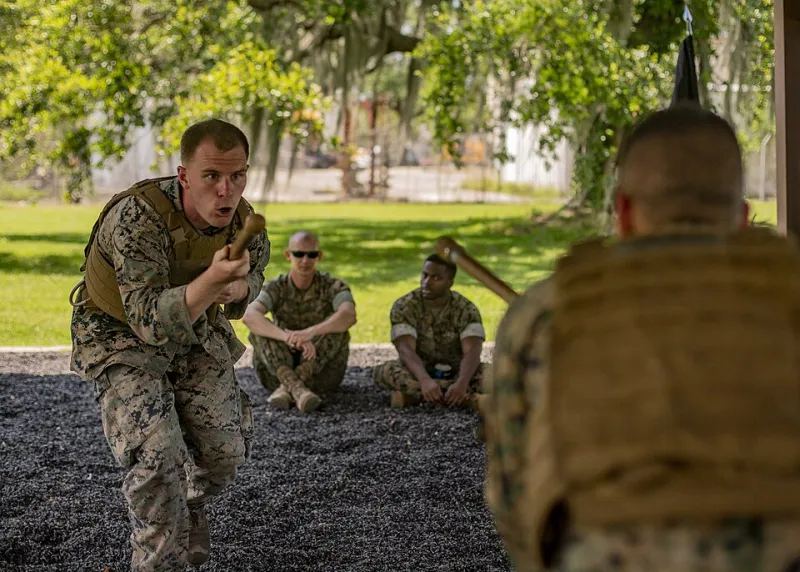
Photo: U.S. Marine Corps photo by Lance Cpl. Jose Gonzalez, Public domain, via Wikimedia Commons
Most self-defense students arrive at their first class with the same assumption: that learning a technique means they will be able to execute it under pressure. They drill the wrist escape. They practice the elbow strike. They rehearse the verbal commands. Then, in a simulated high-stress scenario, something unexpected happens — nothing. They stand motionless, mind blank, body rigid, as if the hours of training simply evaporated.
This is not a failure of effort or intelligence. It is biology.
What Happens Inside the Brain During a Threat
When the human brain perceives danger, a cascade of neurological events begins within milliseconds. The amygdala — a small, almond-shaped structure buried deep in the temporal lobe — functions as the brain's threat-detection alarm. Before your conscious mind has processed what is happening, the amygdala has already signaled the hypothalamus to flood the body with stress hormones, primarily cortisol and adrenaline.
The result is the well-known fight-or-flight response. However, neuroscientists and combat psychologists have long recognized that the popular two-option framework is incomplete. The freeze response — sometimes described as tonic immobility — is equally common and, in many cases, the dominant reaction to sudden, unexpected threat.
Dr. Peter Levine, a leading researcher in trauma and somatic psychology, has described the freeze state as an evolutionary survival mechanism. In the animal kingdom, playing dead can save a life. In a modern self-defense scenario, however, it can be catastrophically counterproductive.
During a freeze, the prefrontal cortex — the region responsible for rational decision-making, verbal communication, and learned motor skills — is effectively taken offline. The brain, perceiving mortal danger, prioritizes ancient survival circuits over sophisticated learned behavior. This is precisely why a practitioner who has drilled a technique hundreds of times may be completely unable to access it during a real confrontation.
Why Conventional Training Falls Short
Traditional martial arts and self-defense instruction is built on a model of repetition: perform a technique enough times, and it becomes automatic. This approach has genuine merit. Muscle memory is real, and procedural memory stored in the cerebellum is more resistant to stress than consciously accessed information.
The problem is that most training environments do not adequately replicate the neurological conditions of an actual threat. A well-lit dojo with a cooperative training partner produces a fundamentally different internal state than a dark parking garage with an aggressive, unpredictable attacker. Stress inoculation — the deliberate exposure to elevated physiological arousal during training — is largely absent from mainstream curricula.
Combat psychologist Dave Grossman, whose research on human performance under extreme stress has been applied in military and law enforcement training, has documented how fine and complex motor skills degrade significantly under high adrenal load. Gross motor movements — large, simple, whole-body actions — are far more accessible when the sympathetic nervous system is fully activated. This has direct implications for which techniques practitioners should prioritize and how they should train them.
Evidence-Based Approaches to Training Past the Freeze
The good news is that the freeze response is not inevitable. With deliberate, scientifically informed training, practitioners can build genuine crisis resilience — not merely the illusion of it.
Stress Inoculation Drills
Stress inoculation involves introducing controlled physiological arousal before or during skill execution. Simple methods include performing techniques immediately after intense cardiovascular exercise, when heart rate is elevated and cognitive function is partially compromised. More advanced protocols involve scenario-based training with realistic role players, unexpected initiation cues, and environmental variables such as low lighting or confined spaces.
The goal is not to simulate fear perfectly — that is impossible in a safe training environment. The goal is to repeatedly expose the nervous system to elevated arousal while still requiring functional performance, gradually widening the window in which trained responses remain accessible.
Breathing as a Neurological Tool
Tactical breathing — a technique widely used in military and law enforcement contexts — directly modulates the autonomic nervous system. The most commonly taught protocol involves a four-count inhale, a four-count hold, a four-count exhale, and a four-count hold before repeating. This pattern activates the parasympathetic nervous system, reducing cortisol levels and restoring prefrontal cortex function.
Practitioners who train this breathing pattern consistently can begin to deploy it as a self-regulation tool in the early stages of a threatening encounter, potentially shortening or preventing the freeze state entirely.
Pattern Recognition Over Reaction Time
Combat psychology research suggests that experienced practitioners do not necessarily react faster than novices — they perceive threat cues earlier. Training that emphasizes pre-attack indicators, behavioral baseline reading, and environmental scanning builds a recognition library in the brain that allows the amygdala to generate a more calibrated, less paralyzing response.
This is why situational awareness is not merely a soft skill. It is a neurological asset. An individual who has identified a potential threat thirty seconds before it materializes has time for the prefrontal cortex to engage, formulate a response, and initiate action before the full freeze cascade takes hold.
Anchoring Techniques to Simple Triggers
Because complex learned sequences are difficult to access under extreme stress, effective training should anchor a small number of high-value gross motor responses to simple verbal or physical triggers. A single word — spoken aloud or internally — that the practitioner has repeatedly paired with a specific movement during training can serve as a bridge between the panicking amygdala and the trained response stored in procedural memory.
This technique, borrowed from sport psychology's use of performance cues, effectively creates a shortcut that bypasses some of the cognitive disruption caused by adrenal flooding.
Building a Training Practice That Accounts for Biology
For Formation practitioners, integrating these principles does not require access to specialized military facilities or elite coaching. It requires intentionality.
Begin by incorporating brief stress inoculation into every session — even something as simple as performing your primary defensive techniques after two minutes of maximum-effort burpees. Practice tactical breathing daily, not only in the gym, but in ordinary stressful situations, so that the pattern becomes reflexive. Study pre-attack indicators and practice reading environments whenever you are in public spaces.
Perhaps most importantly, recalibrate your definition of readiness. A practitioner who has only trained in calm, cooperative conditions is not prepared — regardless of how technically proficient they appear. Genuine preparation means having trained the nervous system, not merely the muscles.
Your brain was built for survival. With the right training approach, you can ensure that survival instinct works with your skills rather than against them.