Stronger Together: How Group Training Builds the Self-Defense Skills Solo Practice Never Can
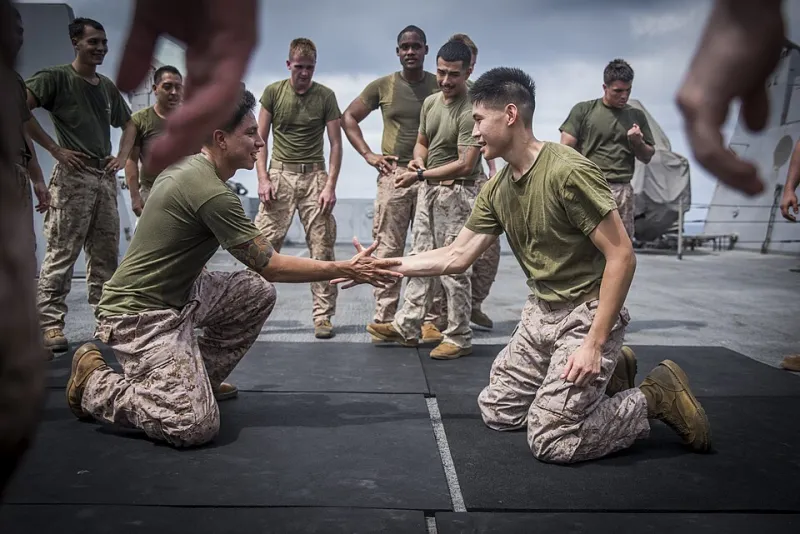
Photo: U.S. Naval Forces Central Command/U.S. Fifth Fleet, CC BY 2.0, via Wikimedia Commons
There is a certain comfort in training alone. You set your own pace, choose your own music, and answer to no one. For many Americans who begin their self-defense journey, solo practice feels like the logical starting point — shadowboxing in the garage, watching instructional videos, rehearsing techniques in front of a bathroom mirror. It is a reasonable entry point, and it is not without value.
But at some point, that comfort becomes a ceiling.
Real-world threats do not arrive on your terms. They do not wait for you to feel ready, and they certainly do not move in predictable patterns you have rehearsed a hundred times alone. This is precisely why group self-defense training — the kind built on partner drills, scenario-based exercises, and shared accountability — produces practitioners who are genuinely prepared rather than merely confident in isolation.
The Neuroscience of Learning Under Pressure
Muscle memory is not simply repetition. It is repetition under conditions that approximate reality. Research in motor learning consistently demonstrates that skills practiced in variable, socially dynamic environments transfer more effectively to novel situations than those drilled in sterile, controlled settings.
When you train with another person, your nervous system is processing an entirely different category of information. You are reading micro-expressions, adjusting to unpredictable body mechanics, managing the psychological weight of resistance, and learning to execute technique while your heart rate climbs. These are not abstract concepts — they are the precise conditions you will face if you ever need to defend yourself.
Solo practice can build a foundation. Group training builds the structure on top of it.
Partner Drills: Where Technique Meets Reality
One of the most significant advantages of community-based training is the introduction of a live, resisting partner. When a training partner applies genuine pressure — even at a controlled intensity — your technique is immediately stress-tested in ways that shadowboxing cannot replicate.
Consider a basic wrist-grab escape. Practiced alone, the movement feels smooth, efficient, and effective. Practiced against a partner who is actively gripping, adjusting their angle, and responding to your movement, the same technique reveals its gaps almost immediately. That friction is not a setback. It is the most valuable feedback available to a developing practitioner.
At Formation Self Defense, partner drilling is treated as the backbone of practical instruction. The goal is never to simply perform a technique correctly — it is to perform it correctly when something is pushing back.
Scenario Training and the Chaos Factor
Beyond individual partner drills, group settings unlock a training tool that solo practice cannot approximate at all: scenario-based exercises involving multiple participants.
Real confrontations are rarely clean, one-on-one engagements. They occur in crowded parking lots, at social gatherings, or in environments where bystanders, noise, and spatial constraints all factor into decision-making. Training in groups allows instructors to simulate that chaos in controlled, progressive increments.
Scenario training might involve navigating a verbal confrontation that escalates unexpectedly, managing distance against multiple training partners, or making rapid decisions while under emotional pressure from surrounding participants playing bystander roles. Each of these exercises deposits something in your tactical bank account that no amount of solo rehearsal can match.
The psychological dimension is equally important. Learning to maintain composure, make clear decisions, and execute physical technique while others are present — watching, reacting, participating — is a skill unto itself. It is the difference between performing and functioning.
Accountability as a Performance Multiplier
Group training also introduces an element that dramatically accelerates progress: accountability.
When you train alone, it is easy to skip the repetitions that feel uncomfortable, to cut sessions short when motivation dips, or to unconsciously avoid the techniques that expose weaknesses. Training within a community removes that escape route — not through social pressure or shame, but through the simple fact that others are present, working hard, and depending on you to show up.
Regular training partners learn your tendencies. A good partner notices when you are favoring your dominant side, when your defensive posture collapses under fatigue, or when a particular technique is not landing the way it should. That kind of targeted, real-time feedback is impossible to generate independently.
Furthermore, the social bonds formed in group training environments create a sense of commitment that transcends individual motivation. You are not just training for yourself — you are part of a formation, in every sense of the word.
Building Confidence That Holds Under Pressure
Perhaps the most significant distinction between solo and group training is the nature of the confidence each produces.
Solo practice generates what might be called theoretical confidence — a belief that your techniques will work because they have worked in rehearsal. This type of confidence is fragile. It has not been tested against resistance, uncertainty, or the psychological intensity of genuine confrontation.
Group training generates tested confidence. When you have successfully applied a technique against a resisting partner, navigated a scenario exercise that elevated your heart rate and demanded real decisions, and received constructive feedback from peers and instructors over time, your confidence is grounded in evidence. It holds under pressure because it was built under pressure.
This distinction matters enormously in high-stakes situations. Theoretical confidence can evaporate the moment a threat materializes. Tested confidence tends to activate the training that built it.
Making the Shift: Starting Your Group Training Journey
For those currently training in isolation, the transition to group-based practice does not require abandoning solo work entirely. The most effective practitioners integrate both — using solo repetition to refine technique and group settings to stress-test and validate it.
If you are located in the United States and looking to begin, Formation Self Defense offers structured courses and community resources designed to bring practitioners together at every experience level. Whether you are a complete beginner or a seasoned martial artist looking to sharpen your practical application, the community environment accelerates development in ways that individual effort simply cannot replicate.
Self-defense is, at its core, a response to an interaction with another human being. It stands to reason that the most effective way to prepare for that interaction is to train with other human beings — consistently, intentionally, and within a structure designed to make you better.
The mirror will show you your form. A training partner will show you the truth.