Your Mouth Is Your First Weapon: Mastering De-Escalation as a Self-Defense Skill

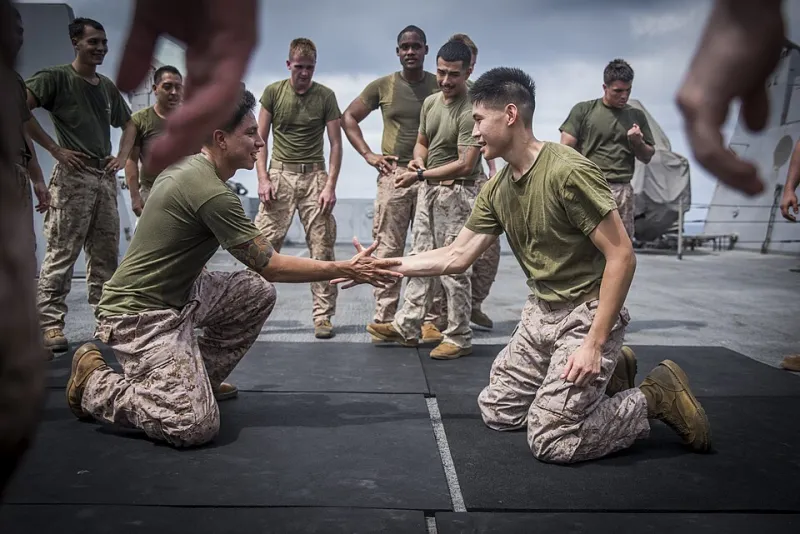
Photo: person calm verbal communication conflict de-escalation body language awareness, via deescalation-training.com
Let us be direct about something the self-defense community does not discuss nearly enough: the overwhelming majority of physical confrontations that occur in the United States were preventable. Not through superior technique, not through greater strength, and not through the ability to throw a harder punch — but through the deliberate, skillful application of verbal and behavioral tools that most people have never been taught to use intentionally.
De-escalation is not a fallback for those who cannot fight. It is the most sophisticated form of self-defense available to any practitioner, and the failure to treat it as such represents a genuine gap in how personal safety is taught and understood across this country.
This is an argument worth making plainly: if your self-defense training begins with physical technique and ends there, you are preparing for the last five seconds of a threat while ignoring the preceding five minutes that determined whether those five seconds were ever necessary.
Redefining What Self-Defense Actually Means
Traditional self-defense instruction — valuable as it is — tends to operate from a specific starting assumption: that a threat has already materialized, that physical contact is imminent or underway, and that the practitioner's task is to neutralize it. This framework produces skilled technicians. It does not always produce safe people.
Safety, in the fullest sense, is not about winning a confrontation. It is about not being in one.
At Formation Self Defense, we hold a broader view of what personal safety training encompasses. Physical technique is essential, and we teach it rigorously. But technique is the last line of defense, not the first. The first line is awareness. The second is assessment. The third is communication. Physical response, when it becomes necessary, is what remains after those layers have been exhausted or bypassed by a genuine aggressor.
Understanding this hierarchy does not diminish the importance of physical training. It contextualizes it — and that context makes every other skill you develop more effective.
Situational Awareness: The Skill That Precedes Everything Else
De-escalation does not begin when someone is in your face. It begins the moment you enter any environment, and it is grounded in the disciplined practice of situational awareness.
Former military and law enforcement professionals — particularly those trained in protective operations — have long operated from a framework that categorizes environmental alertness across a spectrum. The practical takeaway for civilians is straightforward: you cannot respond effectively to a threat you did not notice developing.
In practical terms, situational awareness means making a habit of noting exits when you enter a building, positioning yourself with sightlines to entry points in public spaces, and paying attention to behavioral anomalies — the person whose body language does not match the social context, the individual whose gaze follows rather than wanders, the group whose energy shifts when you approach.
None of this requires paranoia. It requires attention — a deliberate, practiced form of presence that most Americans have been culturally conditioned to suppress in favor of screens and distraction. Reclaiming that attention is a self-defense skill in its own right.
Reading the Room: Body Language as Threat Assessment
Once awareness is engaged, the next layer of de-escalation competency involves reading body language with enough accuracy to assess whether a situation is trending toward confrontation.
Human beings telegraph aggression before they act on it. The signs are consistent across cultures and contexts: a shift in weight toward the front foot, hands moving toward the centerline of the body, jaw tightening, chin dropping, gaze hardening and narrowing. These are not infallible indicators, but they are meaningful data points that a trained observer can register and respond to before a situation escalates.
Equally important is recognizing pre-contact interview behavior — the set of verbal and spatial probing tactics that predatory individuals commonly use to test a potential target's awareness and resolve. Questions that do not quite make sense in context, requests for assistance that require you to close distance or divert attention, attempts to maneuver you toward isolation — these patterns recur with notable consistency and can be interrupted effectively once you know to look for them.
The Verbal Toolkit: Communicating Your Way Out
Assuming awareness and assessment have identified an escalating situation, verbal de-escalation becomes the primary tool. This is where many people feel least prepared, and understandably so — most of us were never taught to communicate under pressure with tactical intention.
Effective verbal de-escalation in a self-defense context is built on several core principles.
Tone over content. Research on communication under stress consistently finds that how something is said matters more than what is said. A calm, even, measured vocal tone — even when delivering a firm boundary — communicates confidence and control. Raised pitch, rushed delivery, or a wavering voice signals anxiety, which can embolden an aggressor rather than deter one.
Clear, non-provocative boundary-setting. Phrases that establish limits without issuing challenges — "I don't want any trouble," "Let's both walk away from this" — accomplish two things simultaneously. They communicate non-aggression, which can reduce the perceived justification for attack, and they establish, for any witnesses present, that you made a reasonable attempt to avoid conflict.
Creating distance without turning away. Physical positioning during a verbal confrontation matters. Moving backward at an angle, keeping your hands visible and slightly raised in a non-threatening posture, and maintaining enough distance to react if the situation deteriorates — these are physical components of a verbal de-escalation strategy. Turning your back or freezing in place are the two most common errors people make when they feel threatened and are trying to talk their way out.
Knowing when to stop talking. There is a point in some confrontations where continued verbal engagement prolongs exposure to danger rather than reducing it. Recognizing that threshold — when an aggressor is no longer responsive to communication and physical action or immediate egress becomes the priority — is itself a critical skill.
Why This Belongs in Every Training Program
The argument for integrating de-escalation into mainstream self-defense training is not a philosophical one. It is a practical one.
Physical confrontations carry legal consequences, injury risk, and psychological aftermath regardless of who initiated them or who prevailed. The individual who successfully avoids a confrontation through awareness and communication has achieved the best possible outcome — no injury, no legal exposure, no trauma.
More Americans are seeking self-defense training than at any point in recent memory, and that is a genuinely positive development. But the training they receive should reflect the full spectrum of what personal safety demands — not just the physical terminus of a threat, but the entire arc that leads to it.
At Formation Self Defense, we believe that the most dangerous practitioner in any room is not the one who can fight the hardest. It is the one who reads the room most clearly, communicates most effectively, and has thought carefully about every option available before a physical response becomes necessary.
Train your body. Train your mind. And train your voice — because in most situations, it will serve you better than your hands ever will.